Dehumidifier
Drying clothes with a dehumidifier: energy use and results
Extraction capacity, room temperature and airflow around the drying rack determine drying time and electricity use.


A dehumidifier can help laundry dry faster indoors by removing the moisture that fabrics release into the air. It is particularly useful when clothes take a long time to dry in a damp room, but it cannot always replace a tumble dryer: it needs space for a drying rack, airflow and time. When choosing one, its actual extraction rate at the room temperature, electricity use and water drainage matter more than Wi-Fi connectivity or a low-energy marketing label.
If you have a problem with your dehumidifier, you can use our free error code finder. It will help you identify and resolve errors easily and effectively.
Water leaves the fabric and ends up in the tank
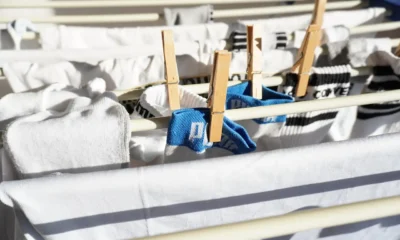
Laundry dries when the water it holds evaporates into the air. If that air is already very humid, evaporation slows down: towels retain cold patches and cuffs stay wet long after the rest of a garment. A dehumidifier helps keep the process moving by reducing moisture in the air. It does not need to touch the laundry or enclose it in a drum, although it cannot overcome every temperature limitation or a poorly arranged drying rack.
In compressor models, air passes over a cold surface where some of its moisture condenses. The collected water runs into a tank or through a manufacturer-approved drain, while slightly warmer air returns to the room. That extra warmth can help with drying, but it is not controlled space heating. The appliance mainly manages moisture; its heating effect depends on its technology, power consumption and operating conditions.
The benefit is most noticeable in a room where hanging laundry raises humidity and causes windows to mist up. However, removing moisture from the air does not fix a water leak or solve a building defect on its own. Nor does it disinfect clothes or guarantee the removal of existing mould. If patches keep returning even when no laundry is drying, wet clothes may be making an existing damp problem worse rather than being its only cause.
Litres per day tell only part of the story
For domestic use, appliances advertised as extracting 10 to 20 litres per day provide a reasonable starting point, not a drying guarantee. The supplied product listings also include units rated at 12, 16 and 25 litres per day. The right choice depends on how much laundry you hang, how often, the room volume and its temperature. Higher capacity can provide useful headroom, but it does not guarantee a proportional reduction in drying time.
Advertised extraction rates are measured under specific test conditions, which should be checked in the model documentation. A unit rated at 20 litres per day will not necessarily collect that amount in a cool home. This makes comparing the test conditions just as important as comparing the headline figure. Where two specifications use different temperatures or humidity levels, their nominal capacities alone cannot establish which will work better beside the same drying rack.
Extraction rate must also be distinguished from tank size. Commercial listings for the Pro Breeze OmniDry describe 12-litre-per-day versions with a 2-litre tank and 20-litre-per-day versions with a 4-litre tank. These are different measurements: tank size determines operating time before emptying, while extraction rate describes moisture-removal capacity. A small container can stop a powerful appliance before the laundry is dry, even when everything is working correctly.
Room temperature can change which appliance makes sense
Compressor dehumidifiers generally extract less moisture as temperatures fall, and they may spend some operating time defrosting. In a cold room, an attractive litres-per-day figure may translate into modest results. What matters is the permitted operating temperature range and, where available, performance information for conditions close to those in your home. It is not enough for the appliance to switch on: its extraction rate and energy use in that room are what count.
Desiccant appliances, which use a moisture-absorbing material, are another option to consider in cooler spaces. The commercial references include the De’Longhi DNS80, advertised with zeolite technology and an extraction rate of 7.5 litres per day. That does not automatically make it the best purchase: technology affects real-world performance, but electrical input, noise and the specific model instructions must also be compared.
At the other end of the market are small appliances advertised as extracting a few hundred millilitres per day. The Cecotec BigDry 2000 Light, for example, is listed at 300 millilitres per day and 23 W. Its low instantaneous power demand does not establish that it can handle a full load of laundry. Removing little moisture over many hours may leave clothes insufficiently dry. Compact dimensions or an impressive-looking tank cannot replace suitable extraction capacity.
The drying rack and room are part of the system
A contained room allows dehumidification to focus on the air around the laundry. Leaving windows open while the appliance runs may continually introduce moisture, depending on outdoor conditions. Generally, drying is more controllable with doors and windows kept closed, without compromising the ventilation the home requires. Do not choose a space that needs permanent ventilation for other appliances, or block ventilation grilles to improve drying performance.
The unit needs a stable surface and the clearances from walls and furniture specified in its manual. Position it near the drying rack but away from dripping water, keeping its air inlet and outlet unobstructed. Placing it beneath wet garments or covering it with a sheet to concentrate airflow creates risks and restricts operation. There is no universal correct distance: it depends on where each design draws in and releases air.
How the clothes are arranged can make as much difference as changing modes. A sheet wrapped around the rack acts like a wall; overlapping towels trap pockets of moisture. Leaving space between individual garments helps air reach wet surfaces. A spin cycle permitted by the care label reduces the initial water that needs to evaporate, although spin speed should not be increased indiscriminately if the garment or washing programme does not allow it.
Laundry mode is helpful, but not essential
A dedicated laundry function usually changes fan operation and humidity control, although its behaviour depends on the manufacturer. Some appliances maintain continuous extraction for a set period; others combine automatic settings. Not every model controls temperature, despite what some commercial descriptions imply. The manual should explain whether the mode ends after a fixed time, according to a sensor reading or through a combination of conditions, because that affects operation and unattended running time.
An appliance you already own may help dry laundry even if its control panel does not include a laundry setting. What matters is that its manual permits the intended use, it has sufficient capacity and it can maintain suitable room conditions. The absence of a laundry mode is not, on its own, a reason to replace it. Before buying another unit, it makes sense to observe whether humidity falls and clothes make progress when arranged properly.
A relative humidity of between 50% and 60% can serve as an initial control reference, rather than a universal setting for every load. The appliance measures air near its sensor, not moisture inside a folded towel. If the humidistat stops extraction while some areas remain wet, review the laundry arrangement and the settings allowed by the manual. A timer limits operating time, but it does not necessarily detect when the clothes are dry either.
Drying takes hours, not just a litres-per-day rating
As a rough domestic guide, drying may take between 6 and 12 hours, but this range should not be treated as a promise. A lightweight, well-spun load behaves differently from towels, jeans and sweatshirts. Temperature, initial humidity and the amount of fabric can extend the process beyond that guide. Without testing the model under comparable conditions, assigning it an exact drying time would be unreliable.
Touch can also be misleading. A cold garment may feel damp even after losing almost all its water, while a thick seam can remain wet beneath an apparently dry surface. Before putting laundry away, check cuffs, waistbands and overlapping areas, rather than just the middle of each garment. The aim is not for the appliance to complete a certain number of hours, but to avoid trapping residual moisture inside a wardrobe where it can encourage odours.
The water collected in the tank cannot directly establish how much moisture the laundry has lost. The appliance may also be removing moisture from the room air, building materials or other sources. The tank is not a laundry moisture meter in isolation. Likewise, collecting less water towards the end can be normal once the room is drier; that change alone does not show that the appliance has lost performance or needs repair.
Energy use depends on power and actual running time
Watts describe electrical power; kilowatt-hours measure energy consumed. At a sustained input of 300 W over 6 hours, the calculation is 0.3 kW multiplied by 6 hours: 1.8 kWh. Running for 12 hours under the same conditions would use 3.6 kWh. These are arithmetic examples, not measurements of a particular model: the compressor may cycle on and off, and different modes can change the power demand.
Running cost is calculated by multiplying that energy use by the applicable price per kilowatt-hour in the electricity contract. Without the tariff and actual consumption, there is no universal cost per load. Maximum power stated in a specification does not necessarily represent the average across a drying session either. When comparing estimates, both must cover the same scope rather than mixing a measured reading with a simple calculation based on rated power.
Adding a heater changes the calculation completely: its energy use must be added to the dehumidifier’s. The same applies to a fan, even though it moves air rather than removes water. A fair assessment includes every appliance used for drying until an equivalent result is reached. Buying the unit with the lowest wattage can be a false economy if it needs many more hours or cannot finish drying the clothes under the available conditions.
A fair comparison with a tumble dryer needs context
Drying with dehumidified air avoids drum movement and the heating associated with certain tumble dryer programmes, which may suit some garments. Even so, the care label still takes priority: some fabrics must dry flat, away from heat or under other specific conditions. Hanging a heavy garment incorrectly can also stretch it out of shape. An appliance that never touches the laundry does not make every hanging arrangement safe for the fabric.
It is not accurate to claim that a dehumidifier always uses less energy than a tumble dryer. The comparison depends on dryer technology, programme, load, previous spin cycle and how many hours the dehumidifier needs. Particularly against a heat pump tumble dryer, any savings need to be checked using comparable consumption figures. One solution also occupies a room while the other contains drying within an appliance; space and the need for clean clothes matter too.
If the main problem is condensation when hanging laundry and a suitable unit is already available, using it may avoid an unnecessary purchase. If large quantities must dry quickly without taking over a room, priorities change. The decision should reflect the household’s actual laundry routine, not a commercial ranking. Nor does a filtration feature, an app or a claim about odour removal establish better fabric-drying performance on its own.
A stopped appliance does not always mean a fault
A unit may stop because it has reached the selected humidity, completed its timer or filled its tank. It may also be in a manufacturer-designed protection or defrost phase. The first check is the status shown on the display and its explanation in the manual. Never assume an alert means the same thing across different brands: even within one manufacturer, messages can vary between ranges and models.
With the appliance switched off and unplugged as instructed, you can check the removable tank, its seating and the accessible filter. Accumulated dirt restricts airflow, while a poorly seated tank may prevent operation. Cleaning should be limited to user-serviceable maintenance parts and follow the specified method. Not all filters are washable, and reinstalling a damp filter where this is not permitted can create problems rather than solve them.
If no water is collected, consider temperature, humidity and settings before deciding that the appliance has failed. A damaged cable, burning smell, water near electrical parts or repeatedly tripped protective devices, however, require use to stop. From that point, the work belongs to a qualified service technician. Do not open the casing, bypass sensors or interfere with the refrigerant circuit; some models use refrigerants requiring specific precautions and qualified personnel.
The right choice finishes the laundry without complications
A larger tank helps with longer sessions, while compatible continuous drainage can avoid intermediate emptying. Check this feature in the documentation: not every unit has a pump or can discharge water at any height. A user-installable hose must be positioned as the manufacturer specifies, without improvised connections to pressurised pipework. Collected water is not drinking water and should not be used for drinking, cooking or filling other appliances unless their instructions expressly allow it.
Noise matters in the mode you will actually use. A quiet label cannot establish how appliances compare without measurement details, and a night setting may change ventilation or extraction. Before leaving a unit running unattended, follow the manual’s operating conditions and consider the appliance’s condition and surroundings. Tank-full shutoff is a useful safeguard, but it does not justify placing the unit beneath dripping laundry or blocking its grilles.
A sound choice combines sufficient extraction at the available temperature, airflow, practical water collection and acceptable energy use over the hours required. The most useful evidence is not the capacity promised in a specification, but how it performs in that room: humidity falls, thicker areas finish drying and new condensation does not appear. That is the difference between adding another appliance to the home and genuinely solving the problem of damp laundry.
This article contains affiliate links: if you buy through them, we earn a small commission at no extra cost to you. More information.


Compressor and desiccant dehumidifiers: which should you choose?

Drying clothes with a dehumidifier: energy use and results

LG THERMA V R290 Monobloc: three heat pump ranges with R290

Blue flame butane heaters: how to use them safely

Iberdrola heat pump aid: up to 5,000 euros per home

Washing machine smells? Clean the seal and leave the door open

How much electricity does a heated towel rail use?

Electric brazier running costs: hourly and monthly use

Electric blanket energy use: watts and monthly running costs

How much electricity does a flame-effect electric fire use?

 Magazine5 days ago
Replacing boilers with heat pumps: CAE multipliers up to x6
- Magazine4 hours ago
Washing machine smells? Clean the seal and leave the door open
- Ariston7 days ago
Ariston electric water heater errors: meanings and solutions
- Dishwasher6 days ago
Indesit dishwasher errors: codes, lights and safe checks
- Candy6 days ago
Candy tumble dryer error codes: warnings and safe checks
- AEG5 days ago
AEG tumble dryer error codes: what they mean and what to do
- Oven5 days ago
Siemens oven error codes: meanings and safe solutions
- Fridge5 days ago
Liebherr refrigerator errors: codes, alarms and solutions
- Magazine7 days ago
How much a tumble dryer cycle costs in winter, by technology
- Oven5 days ago
Samsung oven error codes: meanings and safe solutions
- Dishwasher6 days ago
Haier dishwasher error codes: meanings and solutions
- Magazine4 days ago
Gas inspection every 5 years and boiler service every 2 years